This piece is adapted from an episode of my Irish-language podcast, Gaeilge Thar Lear, recorded after reading Jonathan Haidt’s The Anxious Generation.
A Celtic Tiger Childhood
I was born in 1991, which makes me, depending on who you ask, either a Millennial or a Celtic Tiger cub. Looking back, I think it was a genuinely good time to be a child in Ireland — though I should say upfront that this isn’t a definitive history of the nineties. These are my memories, and my memories alone.
The Church had loosened its grip by then, at least in the world I grew up in. We went a few times a year — Christmas, mostly. Ireland felt modern in a way it hadn’t for previous generations. Money was around. Houses were being built. When I was about thirteen I met a kid named Kelvin who lived in an apartment, and I remember thinking that was genuinely unusual — the first person I’d ever known who didn’t live in a house.
There was still a certain distance from the wider world, though, a lag that’s hard to explain to anyone who didn’t experience it. Films came out in America months before they arrived in Ireland. Blindboy did a brilliant podcast episode once about the early internet users in Ireland who were able to find out what happened in the “Who Shot Mr. Burns?” episode of The Simpsons by talking to Americans online — because Irish viewers were still waiting for it to air. That detail captures something true about that era. We were connected, but not yet fully wired in. The revolution was beginning but it hadn’t taken over yet.
I’m slightly younger than Blindboy — he’s mid-eighties, I’m nineties — but I remember that world he describes. And I think that overlap, that position on the cusp, is part of what makes the Millennial experience interesting. We remember the before, and we lived through the after.
Play, PlayStation, and the In-Between
The childhood I remember was mostly physical. I was out on the street playing football with friends from a young age, without parents hovering nearby. That was normal. That was just what you did.
Indoors, I played a lot of Lego — hours of it, building houses and cities with my friend Stephen. And then, when I was around eight or nine, we got our first PlayStation. The PS1. Rayman, Crash Bandicoot, Spyro the Dragon, Smackdown 2. Around the same time, we got our first computer, and it came with a game on disc — Age of Empires 2, which still has a thriving community twenty-five years later.
As a teenager, Pro Evolution Soccer took over. PES 4 through 6. We were obsessed. My friend Chris and I still reference specific moments from those games — the time Alessandro Nesta somehow scored from the halfway line due to some glitch, the time I ballooned the ball over an open goal with Eric Cantona when I was comfortably winning and getting greedy. These things stay with you.
But here’s the thing I keep coming back to: if you wanted to play video games with your friends, you had to go to their house. That was the deal. And after an hour or two of gaming, you’d end up outside anyway — playing football, walking around, doing something in the real world. I’d go to my friend Donagh’s house to play Smackdown with him and his brothers. His youngest brother Caoimhín used to toddle around in a nappy watching us play. Caoimhín is now a goalkeeper for the Irish national football team.
For online gaming, we went to a place called the WebWorkHouse in Cork city — a LAN party setup where you paid to play Age of Empires against your friends on a Saturday afternoon. Afterwards we’d wander around town. The gaming was part of the day, not the whole of it.
When I was twelve I got my first mobile phone — a Nokia 3510i, bought with my Confirmation money. It was a phone. That was its job. Texts cost around thirteen cent each, so you didn’t send many. There was no WhatsApp, no Instagram, no scroll. There was Snake.
The point isn’t that technology was absent from my childhood. It wasn’t. But it existed alongside everything else rather than replacing it.
What strikes me now is how fast it all moved, even within the span of my own school years. When I started secondary school, the Nokia was the pinnacle of mobile technology. By the time I finished, we’d gone through flip phones and were arriving at the first iPhones. For music, I started with a Sony Walkman and a CD case, moved through MP3 players, and ended up with an iPod — all within a few years. Each shift felt enormous at the time, and we had barely adjusted to one before the next arrived. That pace is worth remembering when people of my generation are tempted to be too hard on what came after us. The ground was already moving fast beneath our feet.
The Anxious Generation
I came across Jonathan Haidt’s book The Anxious Generation earlier this year and read it in five days. I couldn’t put it down.
Haidt’s central argument is that something went seriously wrong with youth mental health from around 2012 onwards, and that it’s connected directly to the arrival of smartphones and social media in the hands of children and teenagers. He draws a distinction between what he calls a play-based childhood — the kind I’ve just been describing — and a phone-based childhood, which is what came after.
I got my first smartphone at around twenty-two. I joined Facebook at seventeen or eighteen, shown how to set up an account by my friend John, who is half-Canadian and wanted to show me the girls he’d met over there. At the time it felt like a social network — a way of staying in touch with people, having a bit of craic online, complaining about maths homework. If you’d told me then that it was also a mechanism for harvesting personal data on behalf of governments and corporations, I’d have thought you were being paranoid.
Social media then and social media now are quite different things, and Haidt’s book is good on why that matters.
I got a glimpse of how much things had shifted when I was on a teaching placement in 2017. I asked a class of ten-year-olds what they wanted to be when they grew up — expecting the usual answers, footballer, pop star, firefighter. The majority said YouTuber. And they were already deep into the world of online “beefs” between content creators. These were primary school children.
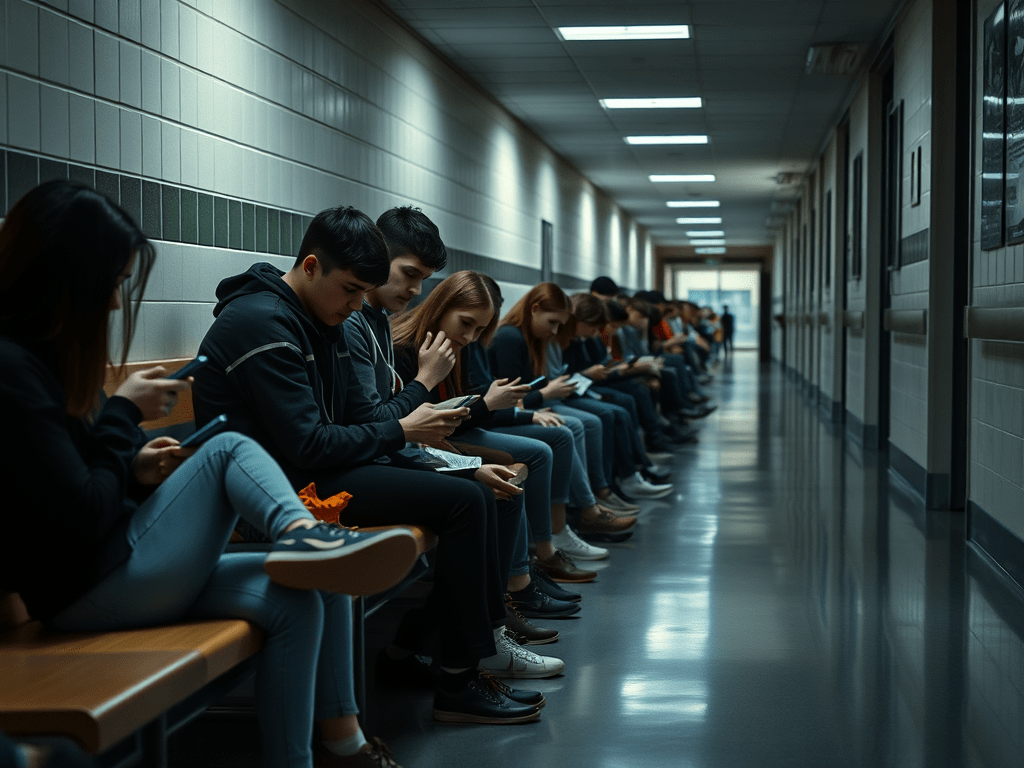
If you’ve watched the Netflix mini-series Adolescence, the second episode — set in a school — gives you a vision of what Haidt is describing: teenagers sitting beside each other, not speaking, lost in their phones. Whether that picture is fully representative or not, Haidt argues it reflects a real and widespread trend, particularly in the United States, and that the mental health consequences have been severe.
For girls, the damage is especially visible. The constant comparison — to peers, to influencers, to algorithmically curated images of what a body or a life is supposed to look like — hits hardest at exactly the age when girls are most vulnerable, roughly between ten and fifteen. That’s also, not coincidentally, around the age when many of them are given smartphones for the first time.
For boys, the picture is different but equally troubling in its own way. Academic performance has been declining. And a growing number of young men are withdrawing from ordinary life altogether, retreating into digital worlds from which there’s less and less reason to emerge. Haidt references the Japanese phenomenon of hikikomori — young men who essentially stop participating in society — as an extreme version of something that’s quietly becoming more common elsewhere. When your bedroom contains everything you need to eat, be entertained, socialise, and avoid the discomfort of real life, the pull inward is powerful.
I’ll be honest: if I were a teenager today, with a device in my pocket capable of all of that, I’m not sure I’d be any different. Look around any bus or train — the adults can’t put their phones down either. We’re not in a strong position to judge.
Looking Ahead
I don’t have solutions. Haidt’s book has some, and his website — also called The Anxious Generation — goes into more detail. If you’re a parent of young children, it’s worth reading. But I’m not going to stand here and pretend I’ve figured out the answers.
What I do have is two young daughters, the older of whom has just started Kindergarten. The questions in the book feel abstract right now, but I know they won’t for long.
One thing Haidt is clear about is the importance of unsupervised time in the real world — climbing things, getting bored, navigating conflict with other children without adults stepping in. The irony is that many parents restrict this kind of freedom precisely because they feel the world is dangerous, when in fact the greater danger may be the one sitting in their child’s pocket. The real irony is that many parents who won’t let their children out of sight in the physical world will hand them a smartphone without a second thought — protecting them from the neighbourhood while leaving them completely unguarded in a far more dangerous one.
I’ve started making physical photo books again. I found a stash of them over Christmas — albums my parents had made of my childhood and teenage years — and they were extraordinary to look through. Far more so than scrolling through Facebook uploads. There’s something about the physical object, the deliberate curation, the fact that someone chose these particular moments and printed them and put them in order. I’ve also largely stepped back from social media myself. That feels right, for now.
One other thing I’d say, for whatever it’s worth: be careful about posting photos of your children publicly and constantly. Send them to family on WhatsApp if you want to share them. But the perfectly curated, endlessly updated social media record of a child’s life puts pressure on everyone — other parents, other children, and eventually the children themselves, when they’re old enough to find it.
My generation had the luck of growing up just before all of this became unavoidable. We remember the world that came before, which means we at least know that a different kind of childhood is possible. That knowledge feels like something worth holding onto.
There’s another dimension to this that I find myself thinking about more and more. In ten years or so, Gen Z will be firmly in the thick of parenthood — the mid-thirties wave of them starting families, with no memory whatsoever of a world without smartphones, without social media, without the constant presence of the screen. They will be parenting from within that world rather than looking back at something different. I don’t say that as a criticism — they didn’t choose the childhood they had — but it does mean that the work of figuring out what a healthy relationship with technology looks like for children will fall increasingly to people who never had the chance to experience the alternative. That feels like something worth taking seriously now, while those of us who do remember still have a role to play in the conversation.

 Oisin O Mahony Blog
Leave a comment