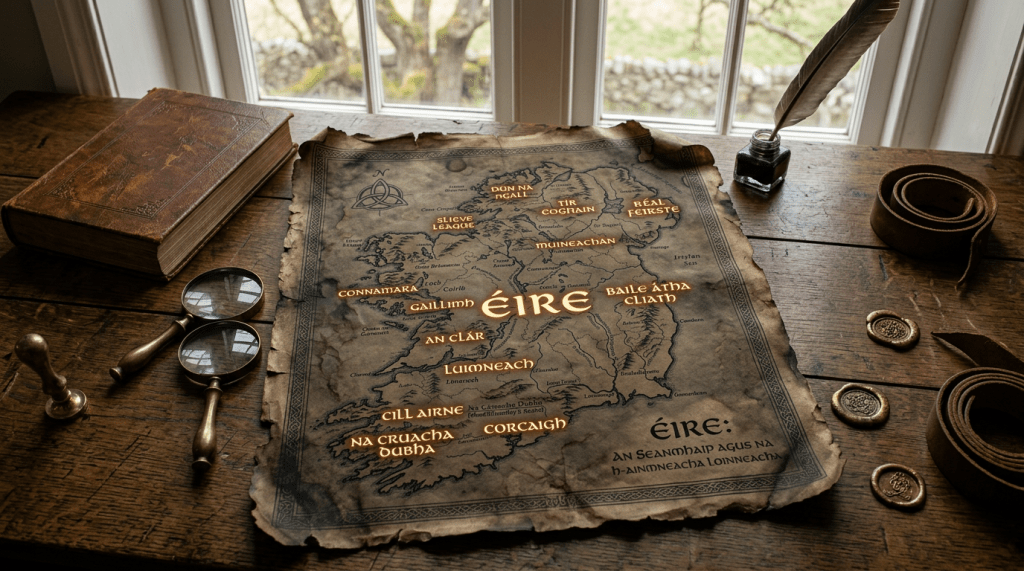
This is a piece from an upcoming “Gaeilge Thar Lear” episode that has been translated and adapted for my blog.
A few days ago I heard something that stayed with me. Donald Trump said he was going to destroy Iranian civilisation. “A civilisation is going to die tonight.”
As it turned out, he did not follow through on the threat — but by the time you read this, who knows. Either way, it was not the threat itself that lodged in my mind. It was the ease of it. The casualness. One sentence to dispose of one of the oldest civilisations on earth — a civilisation that gave the world chess, irrigation systems, astronomy; that outlasted Athens, Sparta, Alexander, the Romans, the Ottomans, the Mongols. Thousands of years of accumulated history and memory, reduced to a headline. To a problem.
That word — civilisation — kept turning in my head. What do we actually mean by it? What is lost when one is erased? What is the connection between people and the land they have lived on for generations, and what happens when that connection is severed?
I happened to be reading Manchán Magan’s 32 Words for Field at the time. The coincidence felt pointed.
I came to Manchán through the Blindboy Podcast — he has been a guest so many times that I have lost count — and later through Ag Triall ar an Tobar, his TG4 series on holy wells. 32 Words for Field is a different kind of book. It moves through Irish-language words for landscape — words from the Gaeltachtaí, from people for whom the land and the language are inseparable — and it makes you realise how much a language can carry that no other language can quite replicate.
Reading it also made me aware of how my own Irish comes through a kind of English-language filter. English is my first language, the language I use most of the time, and that leaves a mark. The Irish in Manchán’s book — rooted in the landscape, shaped by generations of proximity to it — is not a version of the language I recognise in myself.
The book has a chapter on place names that I keep coming back to. Manchán quotes the writer Tim Robinson, who wrote about Connemara: “Irish placenames dry out when anglicised, like twigs snapping off from the tree.”
I have been thinking about that image ever since.
Place names are not just labels. They are archives. They hold history, geography, mythology, memory — often centuries of it. Manchán walks through examples: Cnoc Dhoinn Firinne in County Limerick (anglicised as “Knockfeerina”), which carries a story about the Tuatha Dé Danann and a king named Donn. Carraig na nÓinseach in Waterford — the Rock of the Foolish Woman. And my personal favourite: Cooneenashkirroogohifrinn in Mayo, which is Cauinín Ais Sciorradh go hIfreann — the Little Harbour Going Back to Hell.
Even a town like Clonakilty in West Cork — Cloch na gCoillte in Irish, the Stone of the Forest — tells a story. A stone settlement planted among the trees. The name itself carries the memory of colonisation, hiding in plain sight.
The anglicisation of Irish place names was not accidental and it was not neutral. Colonialism is not interested in learning languages it considers beneath it. The goal is control — to extract resources from the land, to impose order. So rather than learning Irish, the names were transcribed in ways that approximated the sound but stripped out the meaning. What remained were sounds without roots. Twigs snapped from the tree.
Déanann cumhacht an rud casta a shimpliú. Power simplifies what it does not understand. And sometimes that simplification is a form of violence.
I have been watching Hector Oz/NZ on TG4 recently — Hector Ó hEochagáin travelling through Australia and New Zealand, and in each episode sitting down with members of Indigenous communities. Whatever you think of his style, what he does there matters. He makes you look at a place called “New South Wales” and hear what that actually says. It says: there was nothing here before us. It says: the land was empty. It is an act of naming that erases the people who were already there.
The New Zealand government has made some genuine progress on this — promoting Aotearoa, giving te reo Māori visibility in official contexts. A cousin of mine lives there and told me she is learning a few words of Māori now, that it has become much more present in daily life. That is the bare minimum — acknowledging that people were there, that they had their own languages and cultures, that the land was not a blank page waiting to be written on. But it matters.
Colonialism often begins with exactly that fiction: the land is empty, the people are not quite people, the names do not count. The renaming is part of the machinery.
I came across a video recently about illegal settlers — illegal under international law — in the West Bank. It was about olive trees. Old men and women tending groves that had been in their families for generations.
Those trees are not just trees. Olive trees can live for hundreds of years. Think about what that means — a tree that was already old when your grandfather was born. A tree tended by hands going back through generations, whose history is not written in any book but is in the land itself, in the roots, in the muscle memory of the work. That is a living archive. And it cannot be moved, cannot be copied. When it is destroyed, the archive is destroyed with it.
The video was about settlers destroying those trees. Severing those connections. Destroying the evidence that people had been there.
And there is something else. After 1948, new forests were planted over the emptied Palestinian villages — mostly pine trees, species not native to that land. Something strange has happened with some of them. The stones are pushing up through the roots. The stones of the old houses, the old villages. The land is refusing to forget.
The mechanism at work in Palestine is recognisable — the same logic that anglicised Irish place names, that renamed Aboriginal Australia, that called a place “New South Wales.” Arabic place names changed or replaced. The meaning, the history, the connection severed. What remained is a surface without depth. But the mechanism was applied later, more completely, and it is still ongoing.
Foréigean an tsimplithe. The violence of simplification. Not just an attack on land — an attack on continuity. An attempt to erase not just people but the evidence that they were ever there.
I remember going to see Iron Man 2 — this was around 2009, probably for someone’s birthday. I am not a Marvel person, but there I was. Near the beginning of the film there is a montage of headlines. One of them said something like: “East-West relations resolved thanks to Iron Man.”
I remember thinking: there it is. The American hero as the solution to human history. No complexity, no context, no reckoning with why people are in conflict — just the redemptive figure swooping in to fix it. A civilisation of problems, solved by a man in a suit.
It is a blockbuster film. It is not trying to be a geopolitical analysis. I know that. But that image — the world’s complexity flattened into a headline — stayed with me. Because that flattening is everywhere. And it does real damage when it operates at scale. When it comes from the mouth of someone with the power to act on it.
I have been sitting here — someone whose Irish comes filtered through English, someone whose own life is perhaps too far removed from the land, too embedded in the modern world’s tendency toward convenience and abstraction — trying to understand connections I have no direct experience of. Manchán’s world of landscape and language. The deep civilisational time of Iran. The bond with the land that people in Palestine carry in their hands, in their trees, in their names.
I do not fully understand those connections. But I understand enough to know they matter. And I understand that it is not our job — not anyone’s job — to destroy them. The true wealth of the world is not in what can be extracted from it. It is in the diversity of lives, languages, stories and ways of seeing that have accumulated over thousands of years. Every time that diversity is flattened — by a rename, a bulldozer, a casual sentence from a position of power — the world is made smaller and poorer for it.
Maybe the least we can do is refuse the simplification. To sit with the complexity rather than flinching away from it. To acknowledge what we do not understand, rather than pretending it is not there.
The world, as it turns out, is not an Iron Man film.


Leave a comment