This is a follow-up to my earlier post, How I Discovered Professional Cycling, which ended on a cliffhanger. This is the second part of that story.
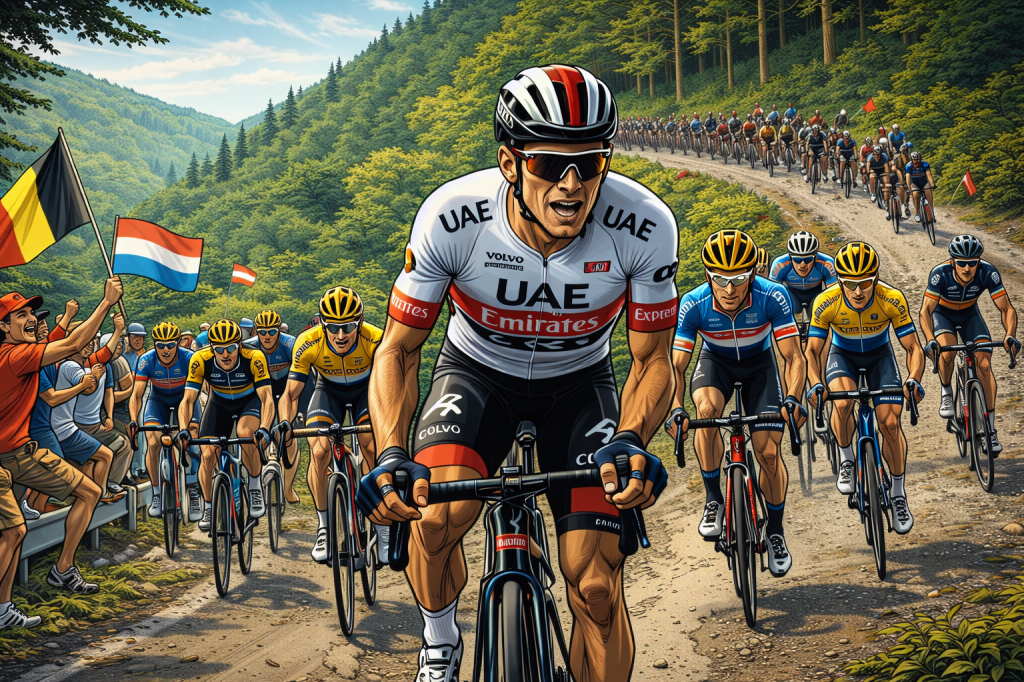
Two years ago, I was standing on the side of a road somewhere in Belgium. Close enough to Liège. The climb is called La Redoute – one of the most famous stretches of road in professional cycling.
I was there with my friend Tanya – a friend from my Erasmus days – her husband Marcus, and their two kids. We were waiting. The peloton was on its way. We were there for Liège–Bastogne–Liège, one of the five Monuments of professional cycling.
Around us were every kind of person you could imagine. A family with young kids. A group of lads who make the same trip to La Redoute every year – a few cans, watch the race, that’s the day. A couple following races across Europe in a caravan. People with flags from half a dozen different countries. All of us waiting for the same thing.
We were waiting, in all likelihood, to see the greatest cyclist in the history of the sport. A man from Belgium – Eddy Merckx -might have something to say about that. But the fact that people are even comparing Tadej Pogacar to Merckx tells you everything.
Two years before that moment, I had no interest in this sport whatsoever. This is the story of how I got back to it.
Where the First Story Left Off
In my previous post on cycling, I described how I first got hooked on the Tour de France during a holiday in Lagos in 2008. I spent an afternoon watching stages with my dad instead of sitting by the pool, and within a few days I was completely absorbed. After that trip, I started buying Cycle Sport and Pro Cycling magazines, following the Tour every summer, and gradually learning about the enormous world beneath the surface of the sport.
And then, gradually, I drifted away. Team Sky’s dominance made the racing feel predictable. College and work changed my routines. The Lance Armstrong scandal left a bad taste. By around 2012 or 2013, I had quietly stopped following.
That’s where I left things. So -what happened next?
Italy, Summer 2022
In the summer of 2022, I was in southern Italy for my cousin’s wedding. Somewhere between the heat, the travel, and the general chaos of the trip, my girlfriend tested positive for COVID. Our last day was spent stuck inside – southern Italy in July, which is not a comfortable place to be indoors.
I found myself scrolling through my podcast feed. And I spotted something: an episode of The Cycling Podcast about what had happened to Michael Rasmussen at the 2007 Tour de France.
I pressed play.
Within about five minutes, I was completely pulled back. The names came flooding back – Alberto Contador, Denis Menchov, Cadel Evans, the whole cast of characters from those years. The scandals. The drama. The complexity of it all. I had forgotten how much I had known about this sport and how much I had enjoyed following it.
Next, I started working through more episodes. And in doing so, I started to get to know the voices covering the Tour that year – Lionel, Bernie, and a Frenchman called François Thomazeau, who had been brought in while the podcast’s main host Daniel Friebe was occupied with television work. Getting to know the voices behind a podcast always matters. Their passion and insight made it easy to come back the next day, and the day after that. On the morning walks and runs before the heat became unbearable, I was listening. They were pulling me through the history and into the present – introducing me to the new names, the new rivalries, the new era of the sport.
What is strange, looking back, is that before I arrived in Italy I hadn’t even registered that the Tour de France was on. It simply hadn’t crossed my mind. But their storytelling changed that. By the time I was heading back to Germany, I was ready for something new to follow. Something to get into properly.
That’s how it started. But it was what happened when I got back that really sealed the deal.
The Disillusionment With Football
It is probably worth explaining one other thing that was going on at that time. For the years when I wasn’t following cycling, football had filled that gap – mainly through podcasts, particularly Football Weekly from The Guardian. I genuinely enjoyed it.
But something had soured. The 2022 World Cup was heading to Qatar, and I found myself increasingly uncomfortable with how the football world had simply… accepted it. The sport that calls itself “the people’s game” – and the people had largely gone along with it. Workers had suffered and died building those stadiums, and nobody with any real platform had stood up loudly enough for long enough. The tournament came. The games were played. And that was that.
What hit me hardest wasn’t the event itself. It was the silence around it. The way it was absorbed into the normal rhythms of the football calendar. I’m not saying I stopped caring about football, but something shifted. I found myself wanting something different from sport.
Le Granon, 2022
Back in Germany, I started watching that year’s Tour de France properly – on ARD, every stage. The Tour had actually already been underway while I was in Italy. I had been following it loosely through podcast episodes on my morning runs and walks, getting the day’s summary in my ears before the heat of the day kicked in. But following a race through a podcast and actually watching it are two different things. It was when I got back to Germany and sat down in front of the television that it really took hold again.
And then came Stage 11.
Le Granon.
If you know, you know. If you don’t, it was one of the most extraordinary stages in recent Tour history. Jonas Vingegaard took the yellow jersey from Pogacar – the defending champion – in an attack that was almost impossible to comprehend in real time. The entire Jumbo-Visma team had worked to set it up. It was strategic, ruthless, and beautiful. The defending champion cracked. The challenger seized the moment.
It was like watching Game of Thrones. Plan after plan, move after move.
After the stage, I went online and read The Guardian’s report. And then, for some reason, I read the comments. Now – reading internet comments is rarely a good idea. But this time was different. The comments section was full of people who were simply… electric. They were analysing Primož Roglič’s attacks, discussing Vingegaard’s plan, marvelling at how the whole team had moved as one unit. There was excitement. There was wonder. And there was – noticeably – almost no animosity. No hatred. Just people from all over the world sharing in something they had just witnessed.
And that was the moment I knew: I was back.
Something I Love About Cycling
That moment in the comments section pointed to something I had been half-aware of for years but never quite articulated to myself: cycling has a different culture around it than most other sports.
There is no tribalism in cycling — not in the way you find it in football. When I was living in Dortmund in 2015 and 2016, I went to a Dortmund–Schalke derby. The atmosphere was extraordinary. Genuinely unlike anything I had experienced. But there was something about it that felt, as strange as this sounds, intellectually unsatisfying.
I grew up following Cork hurling. I understand what it means to follow your own team. But I also remember reading a piece in FourFourTwo about the Dortmund–Schalke rivalry with the headline “A Feeling Deeper Than Hate.” When I was actually living in Dortmund, I can confirm: you couldn’t even mention Gelsenkirchen without it being a loaded moment. I once went to a Schalke game myself and was genuinely a little nervous telling the two men who showed me around that I lived in Dortmund.
That kind of intensity creates atmosphere, for sure. But it can also be exploited. And we all know it is.
Even at Cork City matches – and I love Cork City – I could never quite bring myself to sing “Fuck the Dubs” and really mean it from the heart. I was there. But that particular impulse just wasn’t in me.
And as the world has gone further and further down that road – online especially, but in every direction – the appeal of a sport without tribalism at its core has only grown for me.
In cycling, you can admire Pogacar and cheer for Van der Poel at the same time. You can respect Vingegaard while hoping Evenepoel wins. The hatred isn’t the main character in the story. And for me, at this point in my life, that matters more than it once did.
Back in the Sport
After Le Granon, I subscribed to GCN+. For anyone unfamiliar – GCN+ was the streaming service run by Global Cycling Network, dedicated almost entirely to road cycling and related disciplines like cyclocross. It showed every major race live, and had them all on demand for when you couldn’t watch in real time. On top of that, there were reaction shows, analysis programmes, and an overall package that was genuinely impressive. All of it for around €50 a year. It felt almost too good to be true.
The Cycling Podcast became my main podcast companion through all of it. Between the two, I had more cycling content than I knew what to do with.
And for the first time, I actually sat down and watched the other Grand Tours. I had read about the Giro d’Italia and La Vuelta a España in the magazines back in my first spell following the sport, but there is a real difference between reading about something and watching it unfold. The Vuelta in particular had a completely different cast of characters and a different feel to the Tour – but it was brilliant in its own right. And it was during that Vuelta that Remco Evenepoel announced himself as a genuine Grand Tour force, storming to victory in a way that felt like the sport had found another major protagonist.
I followed the Belgian classics more closely too – De Ronde van Vlaanderen, Gent-Wevelgem, E3 Harelbeke – and gradually came to understand the race I had always been vaguely aware of but had never really engaged with: Liège–Bastogne–Liège.
Two Metres Away
Which brings me back to that hillside in Belgium in April 2024.
Liège–Bastogne–Liège is known as La Doyenne – French for “the old lady.” It is one of the oldest races in professional cycling, first run in 1892, and it finishes in and around the city of Liège after a brutal day in the Ardennes hills. La Redoute is one of the key climbs on the route – steep, winding, and famous enough that serious cycling fans make the trip there every year just to stand on it for a few hours.
Road cycling is a difficult thing to explain to someone who hasn’t experienced it live. You stand on the roadside for hours. And then – they come. And in the blink of an eye, they’re gone.
That’s part of what makes it unique. The race comes to you. It comes to ordinary streets and villages and climbs. You don’t need a ticket. You just need to show up.
La Redoute is not glamorous. It is a steep, winding road somewhere in the Belgian countryside, far from the gleaming Champions League stadiums I grew up watching on television. But it has something those stadiums don’t.
Pogacar attacked about a hundred metres down the road from where we were standing. And then he was coming toward us. There was a sound in the crowd – not a roar exactly, more of a collective intake of breath, a series of gasps and shouts – something different from football or hurling. Something closer to awe.
And then he was in front of me.
Maybe two metres away. For five seconds. Maybe ten.
I could have reached out and touched him. In theory, I could have stopped his race – stepped out onto the road. The greatest cyclist in the history of the sport, in full flight up one of the most famous climbs in cycling, and he was completely, entirely vulnerable to the people standing on the roadside.
That is a strange and powerful thing to sit with.
There is an analogy I keep coming back to. It is like being on the pitch with Lionel Messi as he scores a brilliant goal – not up in the stands, not behind a screen, but actually on the pitch, two metres away, watching it happen in front of you.
That is the feeling. Witnessing greatness in motion, up close.
After Pogacar passed, Mathieu Van der Poel came through – one of the other best riders in the world, particularly dominant on the cobbled classics. Then Richard Carapaz – Giro d’Italia winner, 2019. And the rest of the peloton behind them. All of them right there in front of us.
And then they were gone.
What Sport Leaves Behind
I have been following sport all my life, in one form or another. And I’ve noticed something about what I actually remember.
I don’t tend to look back at results. I look back at moments. And at who I was with.
I remember being in Croke Park in 2003 when Setanta Ó hAilpín scored that goal in the All-Ireland final. My dad – who has watched thousands of matches across his life – said he had never felt anything quite like it. Setanta was nineteen years old. He was 6’4″, half-Fijian, and felt like the future of Cork hurling made flesh. Within a few months, he would be gone to Australia to play Aussie Rules, though none of us knew that yet. He was the future, and he was the present, all at once, in an All-Ireland final with a young and promising Cork team. The stadium shook.
I remember being in Semple Stadium in 2004 – that great era of Cork and Waterford hurling – when Paul Flynn scored that goal from 40 metres. A bullet, straight into the net from an almost impossible distance. Flynn was one of the geniuses of that Waterford team, a team that kept threatening to win an All-Ireland and could never quite get over the line. We were in the Town End Terrace, in among the Cork fans, at the opposite end from where he scored. I turned to my brother. Did that just happen? Did he actually score a goal from there? And then, far away at the other end of the ground, the Waterford fans erupted – and we had our answer.
I remember Seáni Maguire’s goal against Dundalk in the FAI Cup final. That was his breakthrough season at Cork City. Dundalk were the dominant force in the League of Ireland at the time – a genuinely brilliant team by League of Ireland standards – and we had been losing to them in ways that hurt. Losing the league on the last day of the season to them, that kind of thing. Seáni had actually been at Dundalk before Cork City but had never broken through there. And then, in the last minute, after a Steven Beattie throw-in, the ball rolled over the line. There with my dad, my brother, and some friends from university. Just brilliant.
Hundreds of matches across a lifetime. What stays is the story. The person you were there with. The feeling in the air.
Standing on La Redoute in April 2024, watching Pogacar fly past on his way to winning Liège–Bastogne–Liège – that one has joined the list.
One of the benefits of living in Germany is that so many of the great races are relatively close – Belgium and northern France are on the doorstep. There are several races on my bucket list now. And at some point, I’m looking forward to taking my kids.
Those are the moments I’m building toward.


Leave a comment