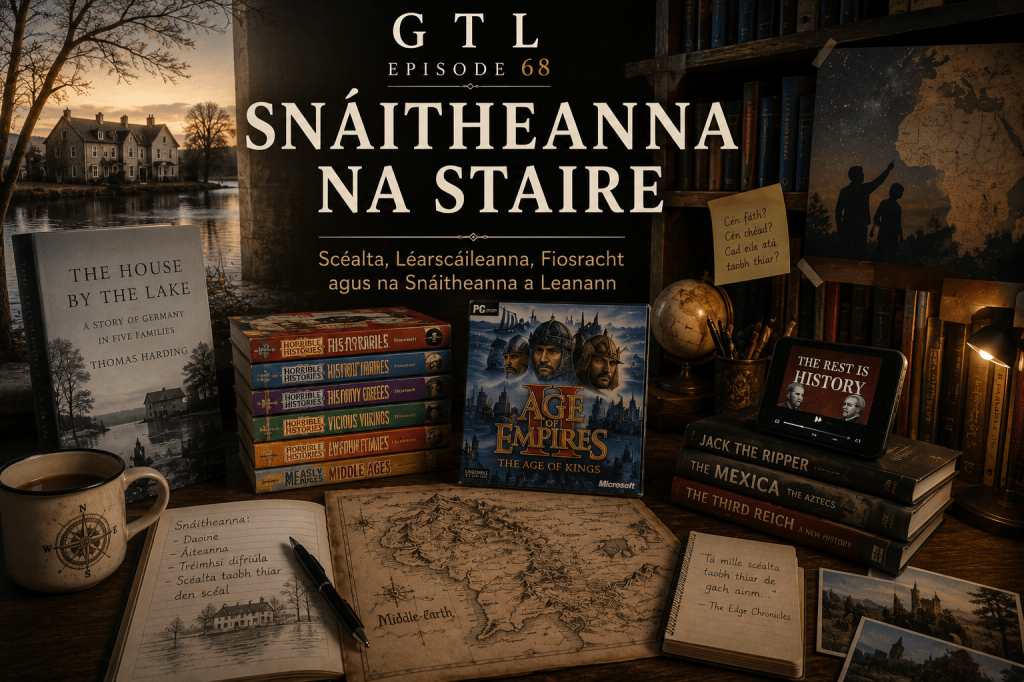
There is a small house beside a lake outside Berlin. Groß Glienicke. I am currently reading a book about it – “The House by the Lake” by Thomas Harding – and it has been sitting on my shelf for ten years. Five different families lived in that house over 120 years of German history, and each family’s story illuminates the era they inhabited: the Kaiserreich, the Weimar Republic, the Nazi period, the war, and the division of Germany into East and West. One of those families, the Alexanders, was Jewish. They were the author’s own family. It is a deeply personal book, and I am glad I finally picked it up.
Reading it, I keep thinking my girlfriend would love it. She always says history doesn’t interest her – but a book like this, built entirely from human stories, would be perfect for her. It is history made of people rather than events. And thinking about that distinction brought me to a question I have been sitting with for a while: why am I so drawn to history in the first place?
The Running Question
A few days ago, I was out early running – 15, 16 kilometres – hooked on a series of episodes from “The Rest is History” about Jack the Ripper. 19th-century London is not even one of my strongest periods. It doesn’t matter. I was completely inside that world at six in the morning. Last winter, it was the Aztecs. Now it is Nazi Germany. After this, it will be something else entirely.
I am drawn to history – but not to any one period or region. Romans, Mongols, the Middle Ages, Celtic history, the Second World War – I can move between them without difficulty and find each one as absorbing as the last. That quality of restlessness, of always moving toward the next world, is worth examining. Where does it come from?
Horrible Histories
To understand it, I have to go back to around the year 2000, when I was nine or ten years old. It started, as it does for many children, with the Horrible Histories books. My brother, three years older than me, was already reading them, so they were around the house. For anyone unfamiliar: books about different historical periods, roughly 125 pages each, full of cartoons and irreverent details. The Egyptians, the Romans, the Vikings, the Aztecs. We read them cover to cover, again and again. My parents were happy to keep buying them.
There was another series alongside them – Dead Famous – the same format but focused on specific historical figures: Joan of Arc, Cleopatra, Henry VIII. Between the two series, history became something you could live inside rather than something that happened to other people in other times.
They were heavily focused on British history, and history is considerably more complicated than they suggested. But that is not the point. What they gave me was the feeling of history – the connections, the threads between things and people and different times. A sense that everything was linked to everything else, that the past was not a collection of isolated facts but a web of causes and consequences stretching in all directions.
I should say here – I was good at history in school and I enjoyed it. But the reason I was good at it was the reading I was doing in my own time. The curriculum and I were not in conflict. I was just doing my own thing alongside it. The school gave me the structure. The books gave me the feeling. And it was the feeling that stayed.
The Lord of the Rings and Age of Empires
It was not only books. “The Fellowship of the Ring” came out when I was ten, and that quasi-Medieval world – swords and bows and arrows, castles and sieges – was not unfamiliar territory. The reading had prepared the ground. Horrible Histories and the books around it had already given me a set of images and reference points – feudal structures, siege warfare, the way those worlds were organised – and when Middle-earth arrived, I had something to bring to it. I could recognise the texture of it. I mentioned in a previous piece the Argonath – those enormous statues beside the river – and how they told me there was history in this fictional world, stories I had not yet seen. That was enough. The implication of depth was sufficient to pull me in.
And when we got our first home computer – around the Millennium, with all the fear that came with the Millennium Bug – we got “Age of Empires 2: The Age of Kings” with it. We were afraid to play it at first, worried about viruses on a new machine. It sat in the box for months, possibly a year, before we finally started. And when we did, it was extraordinary. We began with the William Wallace campaign – the beginner level, very much in the spirit of Braveheart at the time – and exploring the map with that mix of excitement and anxiety, moving our people forward as though each step were a victory, felt genuinely memorable. It remains one of the greatest games ever made. 25+ years after its release, there are still professional tournaments.
The campaigns let you fight alongside Joan of Arc, Genghis Khan, Saladin, William Wallace. There was a section in the main menu where you could read about each person and each civilisation. We read those entries as children, again and again. It was not the most historically rigorous source. But it gave me something more useful than accuracy – it gave me doors. When I later came across those figures in books, they felt like old friends. I already knew something about them. I could place them on a timeline. I had a feeling for who they were.
That is what “Horrible Histories“, “The Lord of the Rings,” and “Age of Empires” had in common. None of them was teaching me history in any formal sense. But all of them were opening doors.
History as Overview
I did not study history in college. A close friend of mine did a PhD in it – his area was the Wars of Religion in France, the Huguenots, the 17th century – and that is honestly one of the periods I know least about. But that is entirely right for him. He is the kind of scholar who goes deep into one period, finds every detail, builds a complete picture. My brother is similar – he has listened to “The History of Rome” podcast from start to finish several times, and loves going fully into a subject.
My father is different again. His interest is mainly in Irish history, but for him history must be connected to the present day, to the lives of ordinary people. He calls them social historians – the non-academic historians, the history you learn by walking streets and talking to people and listening to stories that were almost lost. He wrote a long piece about Mother Jones – Mary Harris – a woman from Cork who became one of the most important labour organisers in American history. Not the kind of person you learn about in school. He read whole books about her life to write it. That is the depth he brings to what he cares about.
Different approaches – and none of them is wrong. But none of them is quite mine either.
What I have, I think, is “overview thinking”. I was never the person who wanted to master every detail of one period. I was always more drawn to the feeling of moving between worlds – looking into something, following a thread, moving on, finding the next thread. Maybe that is not the best style for an academic career. But it suits the kind of reading and listening I actually do.
And what that style gave me was a love of maps. Maps of the Roman Empire, of the Mongol Empire, of Middle-earth. I bought fantasy novels – “The Edge Chronicles“, “Eragon” (“The Inheritance Cycle”) – largely because they contained maps. I remember standing in bookshops as a child and teenager staring at the map of Middle-earth, trying to locate everything relative to everything else. What fascinated me most were the places not shown in the films. I know what Moria looks like. But what about Eregion? South Gondor? The places not even on the map?
“The Edge Chronicles” had an introduction listing all the places in its world – Sanctaphrax, Undertown, The Mire, The Twilight Woods, the endless Deepwoods – and at the end it said: behind every name shown here there are thousands of stories, and this book is only one of them.
That is the feeling. That is exactly what was going through my head looking at those maps. And perhaps it is still going through my head now. There is a map of Middle Earth on the wall beside my bed.
Teaching History
During my teaching placement, a child said to me – ugh, history – and that she had no interest in it whatsoever. I was taken aback. How can you hate history? I did not even understand what that meant. Around the same age – nine, ten – my interest in it was just beginning. And this girl was saying she had none at all. Two people the same age, completely different experiences.
In my final placement, I had to teach history myself. And I failed at it. I did not know how to teach what was in the textbook. Partly this was circumstance – I had serious health difficulties at that time, which I have written about elsewhere, and I could not prepare everything as I would have wanted. But I think there was something else. I had never really learned history through a curriculum in the way the textbook assumed. I had learned it through stories, maps, games, and books. And I did not know how to translate that into a lesson plan.
There was one extraordinary class, though. Every child completely absorbed, every face turned toward me – and I remember the feeling that gives you as a teacher, a kind of magic when it happens. But I was not teaching history that day. It was really an English lesson.
The task was diary writing. Sixth class children, asked to write as a child evacuating London during the Blitz, around 1940. I had a PowerPoint giving them context – bombs falling from the sky, the sirens, the underground shelters, families being separated. Something happened in the room that does not always happen. They were inside it. They were those children.
The inspector was present that day. She said it was good – but pointed out that I had not actually taught them how to write a diary. She was right. But the children had learned something anyway. I know that from what they wrote afterwards.
What they had been doing was storytelling. Trying to enter another world. And that is what I had always understood history to be.
My Children and What Comes Next
I think now about my own children, and what will stay with them.
I do not know whether they will be drawn to history the way I was. That is not specifically what I want – I do not want them to be copies of me. But what I can take from my own parents is this: when they noticed that my brother and I were reading “Horrible Histories“, they did not put limits on us. When we finished “The Rotten Romans“, “The Groovy Greeks” appeared somewhere in the house a few days later. No pressure. No agenda. Just an open door.
My eldest daughter is three years old. A few weeks ago she looked up at the sky and asked: wo hört der Himmel auf? Where does the sky end? I had no answer for her. And I think that is the best kind of question – a question with no simple answer, asked by someone who is genuinely looking upward and outward and wondering.
On her first day at the Kita – the German kindergarten – she made a crown. Stars and moons. The staff there helped and guided her – she is three, after all – but they built on an interest that was already there. That felt like the right approach. Creating a space, not imposing a direction.
The world my children are growing up in will have a device in their hands that can answer any question immediately. Where does the sky end. Who led the Mongols. What are the nearest stars. The answer will be there before the question has time to settle. And there is something valuable in that. But I would like them to be able to hold a question for a while. To be lost in it. To look for the answer themselves.
I had summers like that – whole summers lost in Westeros or Middle Earth or Horrible Histories, with nothing to pull me out. I do not know if my children will have that kind of space. I hope they will. And I cannot simply step back the way my parents did, because the world is different now. Too much pressure and direction is not the answer either. The challenge is how to create an environment, how to leave doors open, how to let them walk through on their own terms.
Maybe the best inheritance I can give them is not history itself. Maybe it is the curiosity that comes with it. The ability to look up and ask: where does it end?
Threads
Returning to that house beside Groß Glienicke.
I am still reading the book, and I think I have a small answer now to the question I was asking at the start. Why am I so drawn to history? It is not about the facts. It is not about memorising dates or battles or names. It is about the feeling – the feeling that comes when you find one of the threads connecting things, people, different times. The sense that there is always more behind what you can see. Follow it. There is more there.
That is what “Horrible Histories” gave me. What “Age of Empires” gave me. What a map of Middle-earth gave me. And it is what this book is giving me now.
I think about my father and the social historians – the history you learn by walking streets, talking to people, listening to stories that were almost lost. And that is exactly what Thomas Harding is doing in “The House by the Lake“. Five families, small lives, small decisions, people who went in and out of the same door without knowing they were part of something far larger than themselves.
I think my father would love it.
And whenever you find one of those threads – in a book, a podcast, a video game, or a map on a wall – the feeling is always the same. There is more here. Follow it.
I think about my daughter looking up at the sky.
Wo hört der Himmel auf?
That is the same question I have been considering about history for twenty-plus years. Where does it end? I do not know. And I do not think that is the point. The point is the looking. And the following.
The threads of history.


Leave a comment