It is a Saturday afternoon in Bonn. I have the apartment to myself for the first time in longer than I can remember – one of those rare bachelor weekends that parents of young children will understand immediately. They do not come along very often… My last one was almost three years prior to this one.
I had a list of jobs to do that weekend – and different goals. I cleaned the apartment on the second evening, and it was still clean the following evening. I ran 19 kilometres one morning as I did not have to get home to change nappies and get people out of bed or help with breakfast – I could take my time, explore and really enjoy my run. I could watch television after dinner without having to go through the rigmarole of bedtime – that daily wrestle…
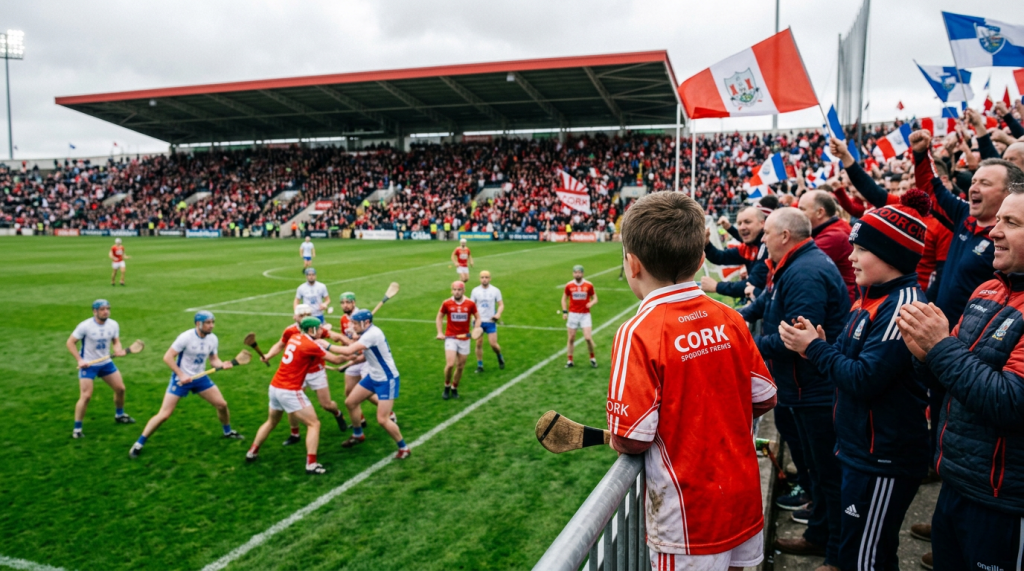
I went through my list of jobs and goals because I had arranged a hot date with the sofa. The All-Ireland Hurling Semi-Final and the Tour de France Stage 1 – same day, same time. I deferred the Tour until that evening and sat down to watch Cork v Galway.
Unfortunately, Cork lost – again – and again in depressing and familiar circumstances… A complete collapse. The following day, Limerick – our neighbours – would be facing defeat to Clare in a battle in the other semi-final… but they would eke out the victory. That is what “great” teams do – and that thought – the difference between a good team and a great, a talented team and a truly great team – started rolling around my head.
Those thoughts were complemented over the coming days by what I would witness in the Tour de France, and to some extent by the World Cup – which I will admit, I have not been following as closely as I could be…
The Paradox
I have been thinking lately about what makes certain teams and players stay with you – and what makes others, however objectively brilliant, remain at arm’s length.
Here is the thing I keep coming back to. The teams you follow most closely – every player known, every game watched, every win and loss felt in your bones – those are the teams you often cannot see clearly. And the teams you watch from a distance, with cool detachment – you can assess them accurately. But they will never mean as much.
I can look at Limerick hurling right now and see exactly how great they are. Potentially six All-Irelands since 2018. A team that produces something extraordinary under pressure almost every time it is needed. I can say that calmly and clearly – because I am not watching them every week. I am not following the sport as closely and as passionately as I once was. There is a gap between them and me. And that gap allows a kind of clarity that closeness never can.
But the teams that stayed with me – Cork in those summers around 2003 to 2006, when we went to the matches and I was completely inside it. Waterford hurling, who never won the big one but who had something that stopped you in your tracks – Mullane, Dan the Man, Paul Flynn, a wildcard capable of beating anyone on their day. Kerry in football, who I did not want to win with a Cork person’s particular visceral investment in their losing – the annoying neighbour who keeps winning, like England in football for any Irish person. Kilkenny under Brian Cody, one of the great teams in any sport, winning everything, breaking every record — and yet I could not fully appreciate them at the time because I was too caught up in why Cork were not at that level.
You have to wait until it is over. Until there is a gap between you and them. And then, looking back, you finally see how special they were.
Outside of Ireland the same dynamic plays out. Chelsea under Mourinho – the pantomime villains, Russian money, not a team you gave your heart to – but when they lost there was a satisfaction you cannot fully explain. Watching from a particular emotional distance, knowing what they meant as a cultural force, makes them more memorable than many teams I followed more closely.
The distance creates something. And when the gap is big enough, you fill it yourself.
Messi, Ronaldo, and the Question of Greatness
During the World Cup I was keeping up through a WhatsApp group – a few friends and my brother, the kind of group that has been running for years and covers everything from politics to memes to sport. A few days into the tournament someone dropped the question in. You know the one. The same question for nearly twenty years. Messi or Ronaldo?
I have nothing new to say about Messi. But the other fella sent me somewhere unexpected.
Not the debate itself – whether Cristiano is better or worse than Messi. Something more specific. A genuine uncertainty I have about whether I can call Cristiano Ronaldo a great in the way the word is usually meant. And when I examined that uncertainty I found something interesting underneath it.
The players I think of without hesitation when the word greatness comes up – Johan Cruyff, Ferenc Puskas, Franz Beckenbauer, Eusebio, players who existed for me entirely in footage and mythology, and the things adults – journalists, football historians, my dad, etc., said about them, carry an unassailable quality. I never saw their bad days. I never watched Cruyff misplace a pass in real time and read seventeen takes about it the following morning. Their greatness arrived to me already formed, already complete, already beyond question.
Then there are players I saw at a younger age, with a little more distance than I have on Cristiano – Thierry Henry at Arsenal, Ronaldinho at Barcelona, Zidane in his final years. I watched them, I remember them, I admired them. But I was young enough, and the media environment was different enough, that a certain mythology still formed. The great moments dominate the memory. The ordinary days fell away.
And then there is Cristiano. Whom I have watched in exhausting detail for twenty years. The goals, the trophies, the extraordinary moments in big games – all there, undeniable. You cannot throw the big game argument at him – he delivered when it mattered. But I have also seen the strops, the me-me-me moments, the games where he took the shot when someone else was open, the sense that the story is always about him. I have seen too much. No gap left. My imagination had nothing to fill in.
I think when he finally retires – when he finally leaves the stage, and some distance begins to form – I will be more comfortable calling him a great. Maybe. Maybe not. The gap may do its work. But right now, watching him in real time, something gets in the way.
R9 and the Mythology of Distance
Which is why I find myself thinking about R9. Ronaldo Fenomeno. The other Ronaldo. The Brazilian.
He was player of the tournament at the 1998 World Cup in France. I was six or seven years old. Friends had older brothers who had seen him — we heard it from them. That is how it worked before the internet was in everyone’s pocket. You relied on the word of the older kids. We had FIFA 2000, which told you he was the best player in the world without question, and you believed it because the game said so. The odd Champions League match on television. A clip on Football Italia on Channel 4. But compared to today – nobody really saw that much of him. You had to piece the mythology together from fragments.
And because of that, it is unassailable. You cannot question it because you never saw the bad games, the bad days. Every bad pass, every mistake – none of it was being clipped and posted online. Nobody was breaking down his pressing statistics in a tactical thread at two in the morning. That oversaturation simply did not exist.
That is the gap. The space between what you saw and what you imagined. And when that gap is big enough, you fill it yourself.
Max Rushden – who presents Football Weekly on the Guardian – made this observation after England’s Euro 2020 semi-final, when everyone was asking if this was one of the great England teams. Rushden said it would be hard for him to say that. Because he had seen too much. Henderson caught flatfooted. Maguire making the same mistakes again and again. Sterling diving, playing for himself when options were there. Pickford flapping at crosses. The greats from his childhood – Bobby Charlton, Bobby Moore, Gordon Banks – lived through his father’s stories, through clips, through things overheard. His father never had Roy Keane and Carragher staring at Bobby Moore’s every mistake on Sky Sports. The mythology grew undisturbed. And that made all the difference.
The gap between what you saw and what you imagined. Fill it yourself and it becomes something unassailable. See everything and the mythology cannot form.
Tadej Pogacar
And yet – there is something the mythology argument does not account for. Sometimes you are watching something in real time, and you know, with complete certainty, that you are seeing greatness. Not hindsight. Not fragments assembled over the years. Not a mythology built in the absence of evidence. The real thing, happening in front of you, undeniable and immediate. And those moments are actually rarer than mythology – because usually the full saturation of modern sport, the analysis and the takes and the constant noise, gets in the way of that simple recognition.
I was back on the sofa when it happened.
Tadej Pogacar. If you do not follow cycling, you may not know the name, but bear with me for a moment. He is a twenty-seven-year-old Slovenian, and he is the best cyclist in the world by a distance that has not been seen in the sport for fifty years. He has won everything and has well over 100 victories so far to his name – that number increases all the time…
He came third in the Vuelta a Espana in his first professional year at twenty – not protecting a result, attacking, going out looking for stage wins.
The following year he won the Tour de France on his first attempt at twenty-one, with an average team and imperfect preparation, against the best riders in the world. When he lost to Jonas Vingegaard two years running, he responded completely — new coach, new nutrition, new approach.
His teammates and rivals, the people who race against him every week and understand the sport from the inside, do not speak about him the way they speak about a great champion. They speak about him as an anomaly. Even among elite athletes – people who are themselves physiological outliers – Pogacar is something different. His VO2 max is among the highest ever recorded. His recovery rate between efforts is faster than anyone else in the peloton. He is, in the most literal sense, a cheat code written into human DNA.
And on top of that – he works as hard as anyone in the sport – if not harder. He trains hard, lives right, has the best team around him, the best material, the best technology. The gifts are extraordinary. But the work is real too.
Earlier in this Tour, on Stage 2, he did something that told you everything about who he is. His team had reduced the lead group to a handful of riders and then Pogacar engineered a moment where his young Mexican teammate, Isaac del Toro, was able to take the stage win. Deliberately, joyfully.
There is a long history in sport of the established champion refusing to make room for the young teammate coming through — the egos, the rivalries, the fear of losing the stage. Armstrong and Contador. Hinault and LeMond.
Pogacar did the opposite. He was as happy as I have ever seen him. And the footage afterwards – Mexican fans in the crowd singing “Tadej, hermano, ya eres Mexicano” – you do not need to know anything about cycling to understand what that moment meant.
But here is the other thing about Pogacar, and it is worth naming before we go any further. He is extraordinary to watch. But the competition around him is not on his level. Not anymore. He is so far ahead of the field that the race often lacks the tension that makes sport worth following — and I find myself looking forward to races he is not in, where the outcome is genuinely uncertain. The 2025 Giro d’Italia was one of the best I followed in years, precisely because Pogacar was not there. Pogacar himself is no less incredible. But dominance at this level changes the nature of the competition around it. Those are two different things, and it is worth keeping them separate.
The Tour is still the Tour. You cannot not watch it. And I was on the sofa waiting for the first mountain stage.
The Tourmalet
Stage 6. The Col de Tourmalet. His team worked from the bottom of the climb, dropping riders one by one. Pog has the best team, and he put them to work – knowing he could keep their ridiculously high pace. When he attacked it looked as if Jonas could catch him – but it was not to be. For a fleeting moment, we thought we would have a competitive Tour de France. However, at the top, he had put 30 seconds into Vingegaard. Then going down at scary speeds – I think at one stage he reached 108 kilometres per hour – he put in another minute on Vingegaard. Then more time on the small rise to the finish – another minute on a not very difficult climb (well, relatively).
Two minutes and forty-four seconds on Vingegaard. In the first mountain stage of the Tour. One stage. The race was over.
I was stunned. In awe, completely. Another Tadej masterclass – another one. Watching something and knowing — this is one of those moments. This is what greatness looks like when it is happening right in front of you.
But somewhere in the back of my mind, a small quiet question I did not want to be there.
Is this too good to be true?
Here is what makes me think it is not. The evidence is human rather than technical. His teammates and rivals say they have never seen anything like it – that even among the best athletes in the world, he is an anomaly. His partner is a professional cyclist herself – his entire life can revolve around the sport in a way most athletes cannot manage, the training and the nutrition and the recovery all aligned. And those with real authority – journalists who have spent careers investigating doping in cycling, rival team managers with every reason to be suspicious – say they think he is clean.
And yet.
Lance
After the Tourmalet I was listening to podcasts. One observation cut through everything else. That Pogacar’s main rival now is himself. His own motivation. The question he has to ask every morning – why keep doing this? Think about being that good. So far ahead that keeping yourself motivated is the greatest challenge. Like a video game you have already completed – every level cleared – and you are still sitting there with the music playing.
The person making that observation was doing so with lived authority. The authority of someone who had stood on a start line knowing that if everything went right, they would probably win. The number of people on earth who truly understand that feeling is vanishingly small.
It was Lance Armstrong. On his podcast TheMOVE.
And that is what makes it interesting. And complicated. He is not an authority on the current peloton. But he can speak to that feeling. And it is Lance Armstrong saying it.
Which is where the small quiet question comes from. Not an accusation. But the history of this sport installed something in every informed cycling fan that cannot be removed. Ullrich. Riis. Hamilton. Landis. Festina. Pantani. Heroes who fell, titles taken. And when you see something you cannot fully explain – something so far ahead of everyone else – that question comes back. Even when you do not want it.
Lance is the most famous symbol of that inheritance. But not the only one. And that is the biggest thing this era left behind — not the titles, not the scandals, but that small quiet question in the back of your mind whenever you watch something extraordinary.
What Stays
If we were to find something out about Pogacar in the future, those memories would not be lost to me. Del Toro taking the stage win, the Mexican fans singing. The attack in Strade Bianche – 80 kilometres from the finish, announced beforehand, and nobody could follow. Stage 6 of the 2023 Tour, holding on the Tourmalet while Jumbo-Visma hammered the pace, holding, holding, and then coming out of the saddle while someone in the crowd lit a flare -30 seconds clawed back, one of the great sporting images of recent years. Stage 17 of the same Tour, 90 seconds conceded in a time trial the day before, cracking on the Col de Loz with 15 kilometers to go and saying on the radio – I’m gone, I’m dead – and then coming back. Winning Stage 20. Finishing second.
Those memories are mine. Nothing can take them.
And I understand the people who still follow Lance. Who never turned on him. Because they were there, watching him at that point in their lives. The feelings were real. The memories were real. No asterisk can take that from them.
I think about that Saturday afternoon in Bonn. The apartment still clean. The hurling on. Cork losing. The Tour starting. A few hours on a sofa with nowhere to be – and somehow, out of that ordinary afternoon, a question about what greatness actually means that I am still turning over weeks later.
That is the thing about greatness. It is never really about the person you are watching. It is about who you were when you watched them. The summers and the stages and the moments – the matches, the characters, the battles – the people you watched it with, the places you watched it from – the tension, the heartbreak, the days when it went right and those it went wrong- they belong to you. They are tied to a particular version of yourself, at a particular age, in a particular place, feeling something you may not have the words for at the time but that stays with you long after the result is forgotten.
The medals, the records and the asterisks – the trophies, the statistics and the objective comparisons – those are for the history books. The rest is yours.


Leave a comment